
The Grumeti Reserve, Great Migration, and the journey in: part one of a travel advisor's Tanzania series
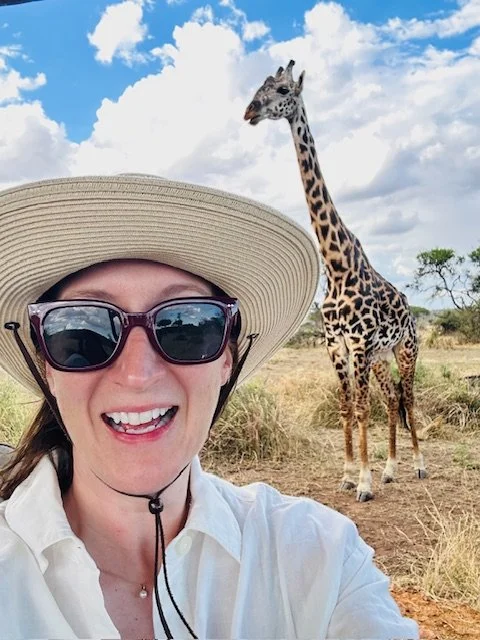
On the drive from the airstrip, a sociable giraffe approached our vehicle, peered in, and held our gaze for a long moment before wandering off. “That's good luck,” said our guide, who'd met us in aviator glasses and green cargo pants with a matching shirt and hat, carrying the kind of safari swagger you can't fake. He'd be with us for all five days in Grumeti, and he was right about the luck. Before sundowners that first day, we'd seen two white rhinos, elephants, two lions, a cheetah, herds of impala and zebra, hundreds of wildebeest, ostriches, and dozens of other birds.
A few days earlier, I had been sliding down a mountainside in Rwanda, boots caked in mud, close enough to a silverback to hear him breathe. The Serengeti asks nothing of you physically. It simply opens up.
This was the final leg of a research trip across South Africa, Zimbabwe, Rwanda, and Tanzania. In Tanzania, I spent five days in Singita's Grumeti Reserves to learn how to better serve travel clients: how you get there, what a private reserve changes, and what the Migration really looks like up close. This is the first of a two-part series. The second, Five Ways to Sleep in the Serengeti, covers the lodge styles and how to choose among them.
National Park or Private Reserve?
Before choosing a lodge, there's a bigger choice most people don't know they're making: national park or private concession. A national park is public land run on government rules and open to every operator. A private concession limits the land to a few lodges, which set their own rules. It's one of the first things I explore with safari clients.
NATIONAL PARK: SHARED ROADS, SHARED SIGHTINGS
In Serengeti National Park, vehicles stay on the roads, there are no night drives, and during Migration season a single big sighting can draw vehicles from several operators at once. You'll still see extraordinary things, just alongside a crowd and from the road.
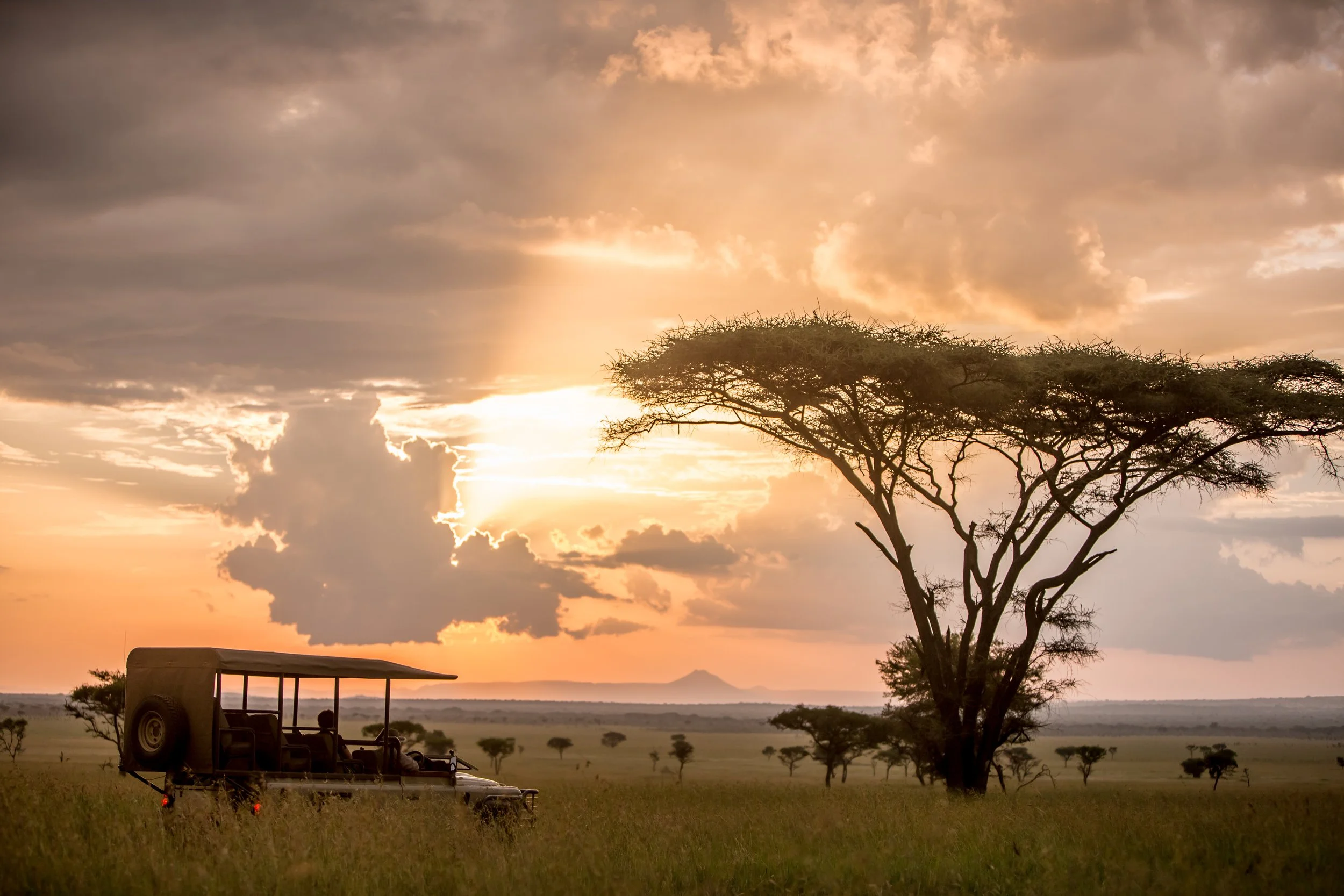
Singita game drive at sunset; photo credit Singita
PRIVATE RESERVE: ROOM TO ROAM
The Grumeti Reserves sit along the park's western corridor: roughly 350,000 acres of private concession on the Migration route, home to Singita's lodges and camps. Here, guides can drive off-road to reach a sighting, and they can lead night drives and guided walks. Singita's conservation partner, the Grumeti Fund, has spent years restoring this land, and Singita credits that work with roughly quadrupling plains-game numbers in the western Serengeti.
In five days, we saw only a handful of other vehicles, mostly in passing. At a sighting, there might be one or two others in view, never a crowd. The guides coordinate with each other so no single spot gets overrun. It makes for a better experience, and I suspect the animals appreciate it too.
THE NIGHT DRIVE
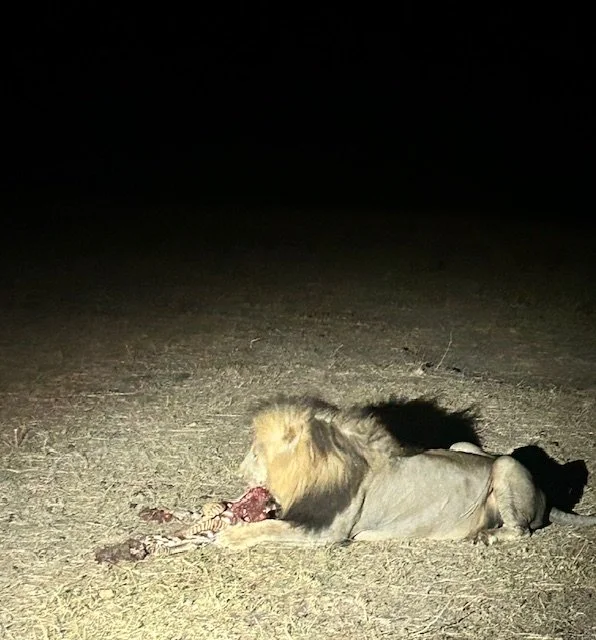
I'll admit I doubted the night drive. Once we were out, I became a believer. After a late sundowner, our guide used long-distance spotlights in different colors to teach us how to spot eyes in the dark and tell blue from yellow. We tracked several lions as they stalked their prey. We missed the kill, but we found about 15 lions at a watering hole, gorging on freshly killed baby zebras and wildebeests. It was gruesome, and the sound of crunching bones was the worst part. It was also unforgettable.
BALLOONING OVER THE PLAINS
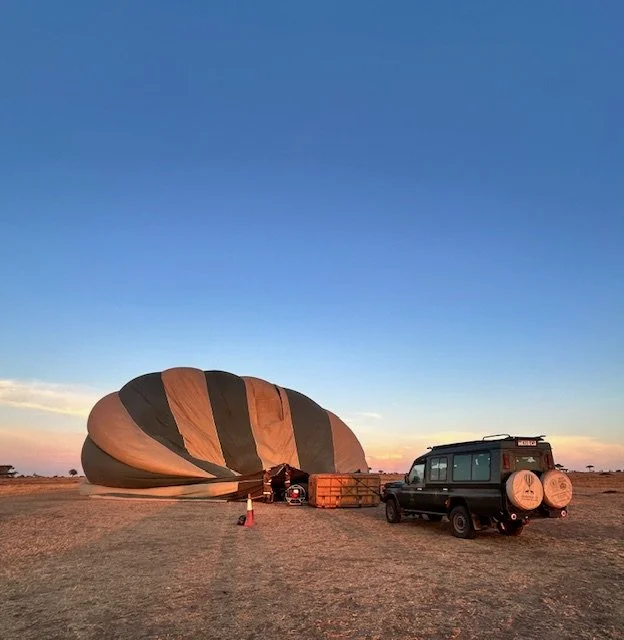
One pre-dawn morning, we drove across the open plains to meet our hot air balloon pilot. Singita books balloons privately, and having ballooned in Morocco, I noticed the differences right away. The basket was about half the size, and instead of climbing in from a step stool, we lay flat on our backs inside it while it rested on its side. It felt awkward and made us laugh, until the balloon filled and the basket tipped upright. (Traveling as a pair? The pilot adds sandbags for balance.)
The landing bumped across the sand, but the pilot kept it smooth. Our guide had breakfast waiting in the bush, with egg sandwiches, juice, and fruit, followed by a champagne toast with the pilot.
RHYTHM OF A SAFARI DAY
The days settle into a rhythm: a 6 a.m. wake-up, the pre-dawn drive, breakfast in the bush, a midday break, the evening game drive, sundowners, and dinner. Nothing replicates a gin and tonic or South African sparkling wine in the bush, with animals roaming nearby and the light changing over plains that don't fit in a photograph.
The Migration Doesn't Keep a Schedule
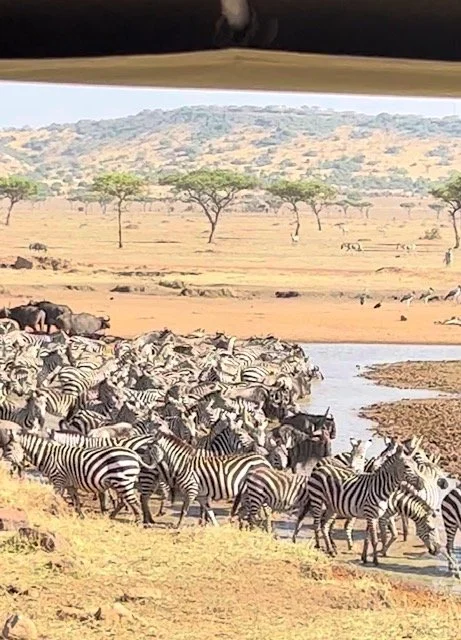
The Great Migration isn't a single event. It's a year-round loop of wildebeest and zebra through the Serengeti-Mara ecosystem, moving with the rains rather than the calendar. If seeing a river crossing is your goal, that's where I come in: timing the trip and choosing the right place to stay.
When we were there, the wildebeest and zebra filed across the plains in perfect formation, and from a distance they looked like a freight train moving across open land. Sometimes we came upon thousands of wildebeest in one area, or hundreds of zebras together. We watched a baby zebra with its mother, maybe a day old, not yet able to walk. I've never seen animals in that kind of concentration. There aren't words for what it looks like.
My advice to clients is not to fixate on one particular spot, unless being there is a lifelong dream. These animals are always on the move, and whatever you see will be nothing like what you pictured until you're standing in front of it.
Small Planes, Big Plains
If you're pairing the Serengeti with gorilla trekking, as I did, the flights from Rwanda are short. (For that half of the trip, read Gorilla Trekking in Rwanda: A Travel Advisor's Account.) Our travel day included a bush flight to a Tanzanian border town to clear customs, which can be hot and slow. Paperwork makes the difference: I make sure clients carry a printed visa and proof of Tanzania's now-mandatory travel insurance, which is separate from personal travel insurance.
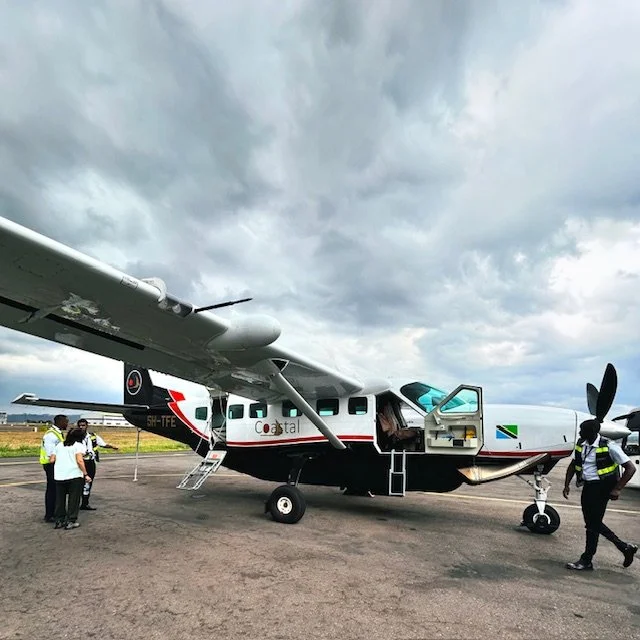
There are no boarding passes on these flights. An attendant guides you through every step, and the co-pilot checks your name against the manifest. The planes are small, 12 seats at most, with limited legroom and the occasional bump, but mostly you're floating low over the savannah and Lake Victoria. It's a sightseeing flight in its own right. Clients who'd rather not share can charter their own plane instead.
Several small airlines fly between the airstrips, including Grumeti Air, Singita's preferred partner, and the luggage rules aren't negotiable: soft-sided duffels only, with strict weight limits. It's the most important packing conversation I have with safari clients. The good news is that the Singita lodges carry a lot of the load. At Sabora, for example, every suite comes with shawls, umbrellas, hats, and ponchos at the entry, and lodges often provide binoculars and blankets as well. Ask ahead about what's supplied, and pack accordingly.
At the other end of the trip, I flew home out of Kilimanjaro International Airport (JRO) through the new Uhuru VIP Terminal, and I book it for any client. Opened in July 2026, it's a private two-level building with lounges, showers, and guest rooms for travelers arriving late or departing early, and it handles check-in, immigration, and boarding away from the main terminal. A luxury vehicle met us on the tarmac while other passengers walked, and Singita's attendant took care of immigration and boarding passes. Having tested the VIP arrival in Kigali too, I book these services at both ends of an East Africa trip. JRO's main terminal is small, crowded, and short on amenities: no place to spend your last hours in the country.
How We Can Help You
Five days in Grumeti changed how I plan every Serengeti trip. I now understand the nuances of traveling here: which comforts I can solve for and help clients anticipate, how the Serengeti differs from South Africa, Zimbabwe, and Rwanda, what the Migration feels and sounds like up close, and how each style of lodging changes the experience. I start by getting to know my clients: their pain points, the goal of the trip, and how they want to feel, and I resolve it all before they land in Africa. Where you sleep matters more than most people think, and that's part two of this series: Five Ways to Sleep in the Serengeti, my guide to the lodge styles, from Singita's tented camps to its private villas and Sasakwa.
If the Serengeti is on your list, let's start that conversation. I handle the rest, from the questions you wouldn't think to ask to bush flights and VIP arrivals and departures that make customs and immigration seamless.
